John Hart
By Bonnie Monte
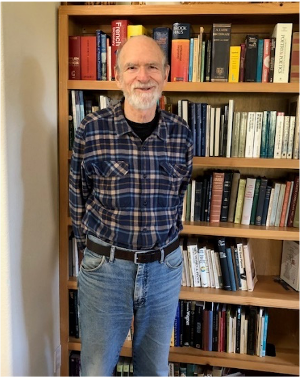
Poet, editor, author, and translator of French and German, John Hart attributes his love of language to being exposed to literary pursuits at a young age. His mother, Jeanne McGahey, was a well-regarded poet; his father, Lawrence Hart, was a poet too but is best remembered as a teacher and mentor. “Yes, he was a poet and a good one,” John acknowledges, “but all his energy went into his students.”
The family moved from Berkeley to Santa Venetia when John was three. “We lived in a very little house that had started as a hunting cabin,” he recalls. There, his father hosted regular sessions with groups of poets. Their style of work became known as activism, which John explains had nothing to do with politics. Rather, it was an attempt to learn from the best of poetry and infuse their own work with active, alive language.
During John’s childhood, the Marin Civic Center was constructed, and his parents were instrumental in what was ultimately built. “The first plan called for dynamiting the hills, but my parents led what would be called a NIMBY uprising about how horrible that idea was.” They got neighbors to sign a petition opposing the plan. When they approached county supervisors, they were brushed off at first. But the county paused the project and eventually Frank Lloyd Wright was chosen to design the building.
Motivated by the first Earth Day in 1970, John began writing an environmental column for the Pacific Sun. “I wrote mostly about issues in the county— water issues, parks, and above all the planning revolution that was going on at that time.” He recalls that before then, the county had plans to urbanize West Marin. “It was thought to be inevitable,” he says. “But there was a revolution in attitude.” The county’s thinking shifted to keeping urbanization in the east, while maintaining an agricultural corridor and a coastal corridor.
John met his wife, Helen, while studying in Germany. After he returned home, they continued a long-distance relationship for years, until Helen moved to the U.S. in 2008. They now live in the same Santa Venetia spot where John grew up, albeit in a newer home. When the original ramshackle cottage was taken down and replaced with a larger home and a studio for Helen’s psychoanalytic practice, the flooring that John’s mother had created was salvaged and now lines a walkway on the property. The new home is filled with books, many of them written by John on environmental topics.
John keeps his father’s legacy alive, continuing his poetry seminars under the auspices of the nonprofit Lawrence Hart Institute and working on publishing a collection of Lawrence’s articles. He also edits the Blue Unicorn poetry journal and writes about water politics and climate change. And of course, he’s still writing poetry.
Chuck & Marilyn
von Schalscha
By Bonnie Monte
SVNA Newsletter July/August 2025
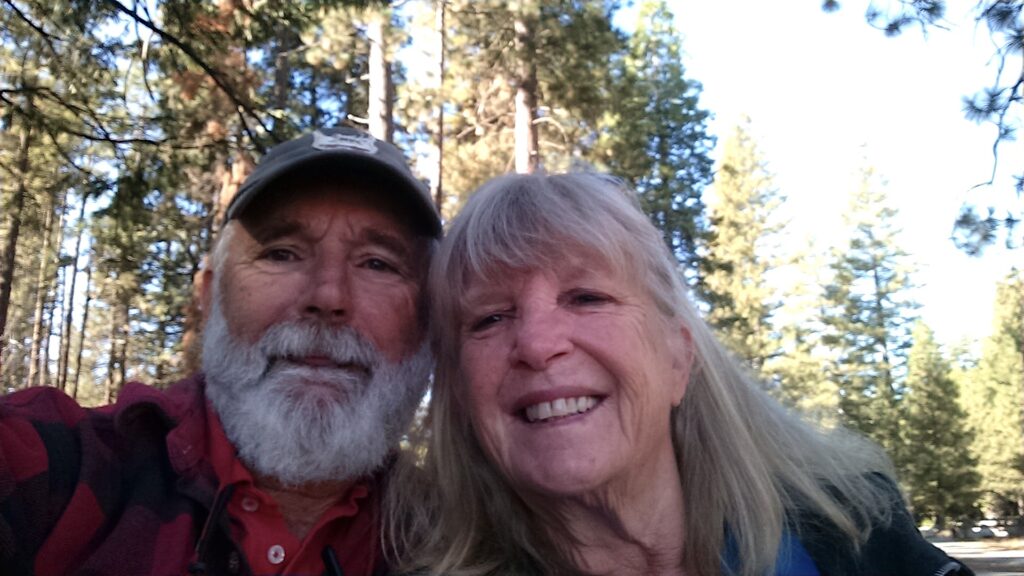
Chuck and Marilyn are delighted that so many young families are moving to Santa Venetia. And Chuck certainly remembers when the neighborhood overflowed with kids back in the 1950s because he grew up in the very house on Vendola that he and Marilyn now live in. “My parents were the original owners,” he says. “Back then, there was nothing across from us. I could see all the way to Buck’s Landing.”
Marilyn moved with her family to San Rafael from Syracuse as a young girl because of her dad’s job with Fairchild, where he was one of the inventors of the LED! The two met at Terra Linda High and began dating when they were both students at College of Marin. They got married in 1969.
When Chuck was in the military, they moved to Sacramento, where they raised their son and daughter. They’ve also lived in Mexico for a season after sailing there, as well as in Pt. Richmond, but moved back to Marin to take care of their aging parents. “Marin has always felt like home to us,” says Marilyn.
Chuck’s dad loved boats, and apparently that fondness is in Chuck’s DNA because he and Marilyn own five vessels. Four are at their home and one is kept at the Richmond Yacht Club. Impressively, Chuck sailed solo to Hawaii in 1988. “That was before GPS,” he reminds me. Navigation was by sextant. There was no email back then either, Marilyn adds. She had no way to check in with her husband during his journey. But she and the kids were on shore in Hawaii to greet him as he sailed in.
Marilyn and Chuck are both active in CERT, working to make the neighborhood disaster-ready. As a ham radio operator, Chuck selected the hand-held radios that all the members have so they can stay in touch in an emergency. He also installed the solar power for the CERT trailer, while Marilyn keeps the trailer stocked with supplies. Practicing simulations of emergencies keeps the CERT team on their toes.
Drawing on her past training in computer programming, Marilyn has been working with Linda Levey to revamp the SVNA website, with plenty of old photos, a more robust archive of past newsletters, and easier navigation. “It’s been fun to use my brain to do that kind of stuff again,” she says. Keep an eye out for the new site, which should be up and running any day now.
Pat Fedorchak
By Bonnie Monte
SVNA Newsletter March/April 2025
One of the things worth cherishing about Santa Venetia is the presence of residents who have been here for the long haul. Pat Fedorchak is one of them, having lived in her home on Galerita since 1953. She, her husband John, and their two young children moved in when Pat was expecting their third child.
Born and raised in San Francisco, Pat met her sailor husband in 1943, and they married two years later. It was actually her parents who saw the new subdivision and fell in love with the place. Pat recalls her first look at Santa Venetia: eucalyptus trees right in the middle of North San Pedro Road, and a glimpse of a cow giving birth. “It was a brand-new neighborhood,” Pat recalls. “The street was still unfinished, with our house the last at the end of a row.” Houses beyond theirs were still to be built. Across the canal was a dairy farm. “At low tide, cows would meander over into our backyard.”
Tweedies, an all-purpose store, stood where the 7-Eleven is now. Vendors selling everything from baked goods to redwood outdoor furniture came door to door, and there were home deliveries of dairy products from Lucas Valley and Roberts Dairies. “It made shopping easy because most families had only one car, which the husband used. It was hard to get to stores,” Pat says. Later, there was a retail area where the homes on Adrian Terrace are now. “We used to have a big barbecue over there,” she says. She ticks off the long-gone businesses: “Littleman’s was a grocery store — they were a big chain in San Francisco. There was a gas station, a pharmacy, a jewelry store, a dentist, a sandwich shop, a dance studio.”
A popular beauty salon was up on the hill. On N. San Pedro Road was Mrs. Fenton’s nursery, which later became Tanem’s Garden Center. There was a yachting club on the canal. And across the water was a drive-in movie. Pat belonged to the Scabo Tennis Club, where she spent a lot of time on the courts. She was also a member of the Gallinas Village Improvement Association, which eventually morphed into the Santa Venetia Neighborhood Association.
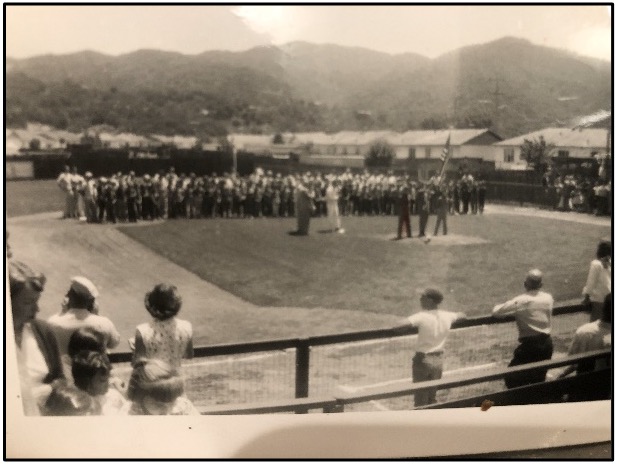
Santa Venetia was filled with young families back then, Pat says. “Everyone had kids, and
they all knew each other. Sports were a big deal.” Pat’s husband managed their son’s Little League team at Castro Field. Pony League was in a field near the president streets, back before the Civic Center was built. Her kids walked to McPhail’s School and to the junior high that’s now Venetia Valley School. “It was a wonderful neighborhood.” Pat’s youngest daughter Tina, who now lives with her, concurs. “It was a great Little League, Opening Day, Late 1950’s place to grow up.” Although the neighborhood has changed a lot over the decades, says.
Mark Rappart
By Bonnie Monte
SVNA Newsletter May/June 2025
If you’ve ever seen True Grit, The Revenant, or The Last Samurai, you’ve seen some of Mark Rappaport’s handiwork. He’s the founder of Creature Effects, a special effects studio in Los Angeles that produces animatronics for film and TV.
Mark was born in Japan and grew up in Napa. He recalls being a less-than-stellar student in high school and at San Diego State, despite working hard. After trying his hand at dozens of jobs – including baker, lifeguard, sailing instructor, cruise ship bar piccolo, fireman, deputy sheriff for Alameda County, and guard at San Quentin – he discovered his passion almost by accident.
In 1988 he was delivering the Sunday New York Times at 6 am, when he happened upon a group of people spray-painting monsters in an industrial area of San Rafael. Mark stopped and told the crew, “I’d like to do this too.” He was hired on the spot. And so began his love affair with model making and puppeteering.
After moving to Los Angeles, he honed his craft at a variety of special effects studios. “L.A. was so busy back then, even if I made a stupid mistake people still hired me,” he recalls. “I learned from people who were good.” Mark went on to found Creature Effects, known for their remarkably lifelike horses that mimic the motions of real animals. Not only is the use of animatronic horses much safer for the cast during stunt work such as falling, it’s also kinder to the horses. Mark pioneered the use of synthetic fur rather than actual horse skin, using an intricate process to affix the fibers to the fabric. “Horses on set don’t like getting near a dead horse,” he explains.
The studio also creates animatronic babies, a boon to filmmakers since real babies don’t always cooperate, and their allowable time on set is only 20 minutes. Mark perfected controls that make the babies’ movements much more lifelike than in the past.
As a result of his many technical innovations, Creature Effects received a Technical Achievement Award in 2017 from the Academy of Motion Picture Arts and Sciences.
After a career traveling all over the world and working with everyone from Tom Cruise to Harrison Ford to Leonardo de Caprio, Mark sold the studio to two of his employees. “I was negotiating with a company in China, but it would have meant that all the employees would be fired.” The deal he landed on meant less money, “but I can feel good about it,” he says.
He’s also working on a curriculum to be taught at his old high school in Napa that encourages students to focus on what they want to do as a career and be open to possibilities. Mark, who lives with his wife in the hills of Santa Venetia, is modest about his many successes. “I always hired people better than me,” he says.